Review – Sharpe’s Tiger – Bernard Cornwell
As a self-confessed book addict, I buy a lot of books that I intend to read. Many more than I actually have time to read these days. Bernard Cornwell’s famous Sharpe series has long been sitting on my shelves, awaiting the suitable occasion to be the next in my reading list. Before even starting the series I came across the age-old problem of reading order. What is the best order to read a series in? Publication order? Chronological order? Best book first? This topic in itself is worthy of it’s own post, so I won’t dwell on the topic but suffice to say that I’m usually a proponent of publication order but departed from that for this series, starting with the chronologically first in the series, Sharpe’s Tiger.
This is also a small departure from my usual fare of Science Fiction and Fantasy novels, but historical fiction has always been in my wheelhouse, as a shelf of Christian Jacq’s Ramses series dating back to my childhood can attest to. I hope my usual readers can forgive, and appreciate, this transgression.
Whether having read the novels or through Sean Bean’s excellent on screen portrayal, Richard Sharpe has become somewhat of an iconic character. Before having read the books, and without having seen the series, I could still tell you a lot about the character, so much has he permeated the cultural consciousness. A “commoner” officer in the British Army in the days where the officers were of a certain class, certainly a ruffian, a violent man when necessary, but with his own code of honour. These were my preconceptions, and it unsurprisingly turns out I was right.
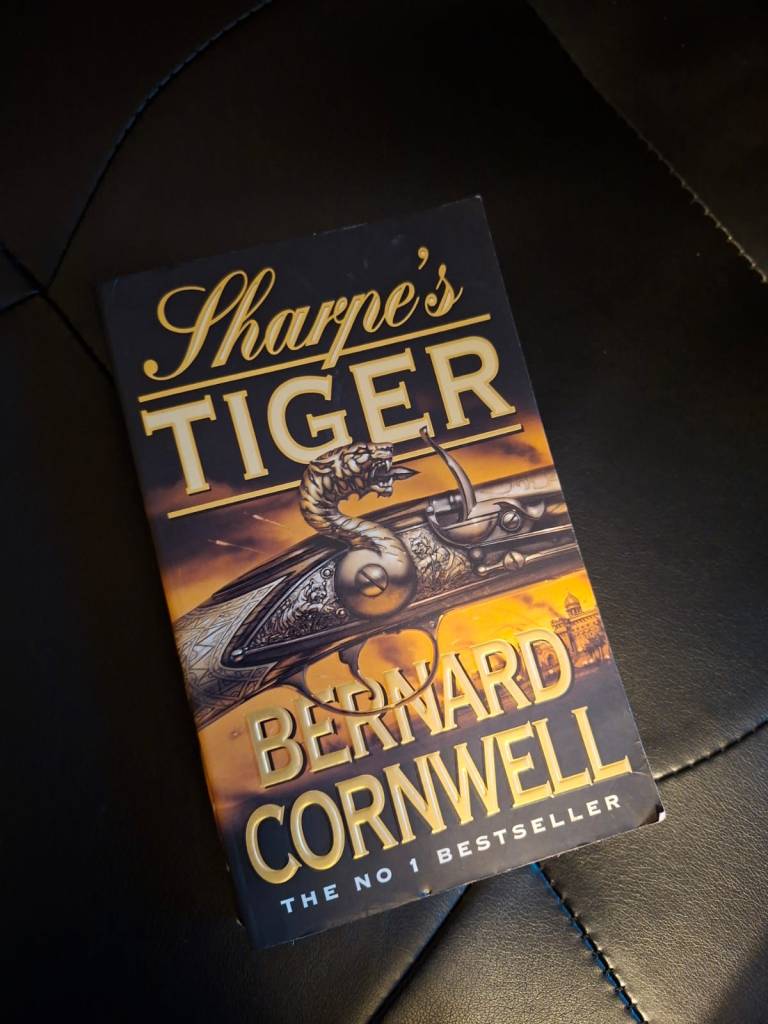
Sharpe’s Tiger is the first in the series (chronologically, fifteenth in publication order for those wondering), set at the Siege of Seringapatam in the year 1799 a few short years before the outbreak of the Napoleonic War which I understand takes up the bulk of Sharpe’s military career. This first outing has Richard Sharpe as a Private in the British Army during the invasion of Mysore, and tracks his heroics on his way to achieving his Sergeant stripes. I will, as always, avoid any more spoilers.
It’s a great adventure story, with villains galore on both sides of the actual conflict. This point being particularly important as it builds so much into Sharpe’s character. He is above all else a soldier. He fights for the British, not for any particularly ideological reason but because that’s the side he happens to be on. The most reprehensible character in the whole story, a certain Sergeant Obadiah Hakeswill, is also in the British army and while he is technically on the same side as Sharpe in the battle, he is certainly not on Sharpe’s side. The obvious counterpoint to this being a French Colonel Gudin, an advisor to the enemy, who is dignified, principled and earns Sharpe’s respect. This nuanced take on the nature of war adds a lot of depth and reality to the story. Many soldiers were there just for the paycheck, because they were running away from worse fates, or because they had no other options. When it comes to battle, you fight like a devil for the man at your side because if you don’t neither you nor he will survive.
The greatest compliment I can give this story is that it did indeed feel real. The characters all felt real, indeed many of them were real people, their motivations felt real, and their actions all felt real in the context of the hellish environment they found themselves in. Even the nefarious and sadistic Hakeswill felt like the type of person that could and would exist in such a situation, albeit dialed up to the level of a caricature. At all times were you rooting for Sharpe to survive, to find a way to win, to wreak vengeance and to give the villains their comeuppance. And of course, like all good adventure stories, the ending is gratifying. I feel I can say without spoilers that Sharpe survives, otherwise none of the other novels would exist, and if anyone is worried about spoiling the outcome of the Siege of Seringapatam itself then I’m afraid to say it’s been in the history books for over two hundred years, I can’t be blamed for spoiling that one.
I will finish this review with a confession. I mentioned earlier that many, in fact nearly all, of the characters are genuinely real people and many of their actions are a fact of historical record. Despite this fact, it took me far too much of the novel to realise that the regiment commander Sharpe served, a man by the name of Colonel Arthur Wellesley, was in fact THE Arthur Wellesley, future Duke of Wellington. I feel confident that many readers starting the series at this point would also miss this fact. I feel equally confident that many people who know me in the real world will be disappointed that I missed this initially. To those people, you’re right and I apologise. To everyone else, go and pick up a Sharpe novel, they are as good as people say they are.
All links to Blackwells or Amazon are affiliate links and Zealot Script earn a small commission for any purchase made via the links. This helps support the running of the site and our continued production of content.
 Zealot Script