Featured Friday! Adrian Tchaikovsky
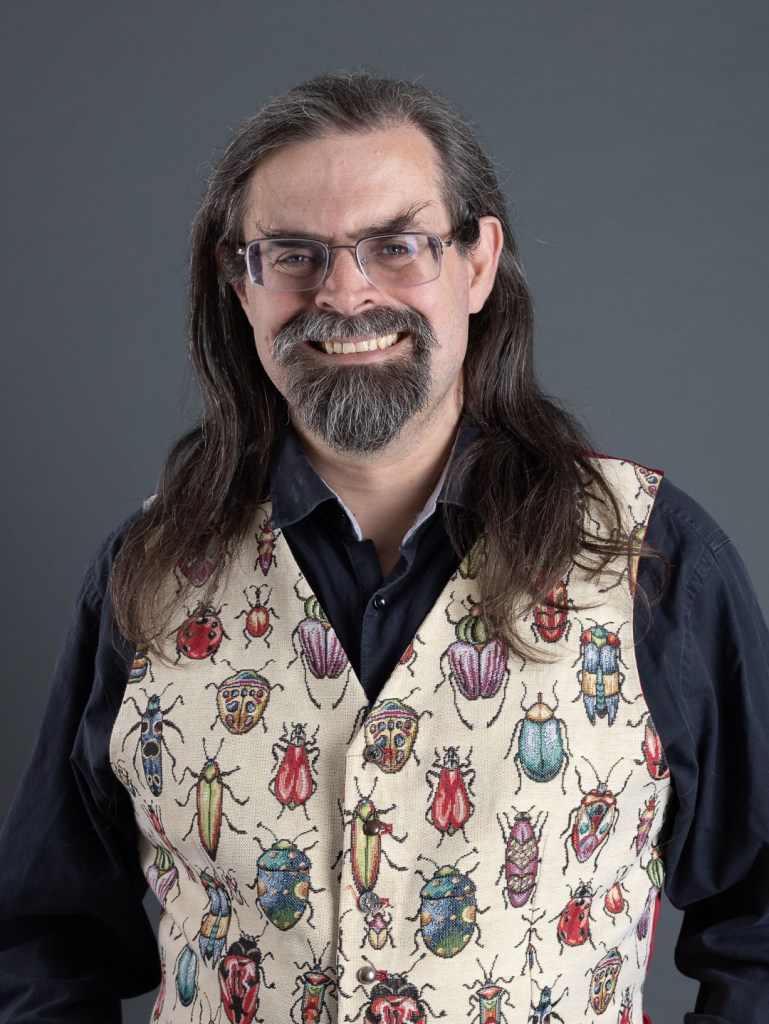
Adrian Tchaikovsky is a British science-fiction and fantasy writer known for a wide-variety of work including the Children of Time, Final Architecture, Dogs of War, Tyrant Philosophers and Shadows of the Apt series, as well as standalone books such as Elder Race, Doors of Eden, Spiderlight and many others. Children of Time and its series has won the Arthur C Clarke and BSFA awards, and his other works have won the British Fantasy, British Science Fiction and Sidewise Awards.
What’s your favourite part of the lifestyle of an Author?
I’m not sure I have anything approaching a lifestyle! Getting to write for a living is surely the best part of the deal. Being a part of the wider writing community is fun too.
What made you start writing?
Discovering the Dragonlance books, which led me from my hobby of tabletop RPGs to stories in prose. There are a lot of transferable skills between them.
Is there an Author that you consider your inspiration?
Many, but I think Gene Wolfe is one of the biggest, if only because he writes such unique novels. Nobody else works on so many levels at once.
What’s your number one tip for an aspiring Author?
Always a tough one to answer. Tell the stories that you want, maybe. I think it’s easy to try and chase the market, but the market moves on, and everyone else is chasing it too. Only you can write the stories unique to you.
What type of book do you like to read and does this differ from the genre that you prefer to write?
Honestly I’ve always read mostly SF and fantasy, very much the same that I write. I am always on the lookout for writers who can do things I can’t, or who have really original ideas – I tend to avoid books that just tread the same circle.
Which one of your characters would you most like to spend time with?
Some of the quieter ones. Much like I wouldn’t want to live in most of my worlds, I think a lot of my characters might be a bit wearing. Idris, maybe, or Yasnic.
Which book do you consider a must-read?
I’m a strong believe that no book is a must-read. A lot of people try to establish a canon, and gatekeep whether someone’s a real reader or fan unless this or that work has been read, and that’s never useful. I mean, I’d say the Gormenghast series is an absolute classic, books I love passionately, but no book is for everyone.
What’s been the hardest edit that you’ve had to make? Why did you want to keep the material in?
There have been so many, and the really hard ones are always the same. There’s a big old chunk of worldbuilding that I want desperately to showcase in the book, but it just doesn’t perform any useful function, takes up space and slows things down, so it has to go.
If you could live in a book, which one would it be?
I mean, most books are terrible places. You get very cramped between the pages. For book settings it’s hard to improve on Banks’ Culture books, being a far future utopia where you can basically have anything you want so long as you’re not an asshole to other people. Of course, there’s a reason most of the books take place just past the borders of it…
If you could pick an Author to write your biography, who would it be?
There is basically zero of interest in my life aside from the books, which people can read independently. So someone good at flash fiction I guess.
Is there any conflict between what you want to write and what you think your readers will like?
Not so far, though I am vaguely aware of a sort of tether distance from my core writing – the further out I go, the more readers I’d likely lose. There’s definitely sometimes a clash between what I want to write and what publishers want to print!
What effect can a review have on you, if you read them at all? Both the good and the bad.
Well a good review is lovely for the brief time it takes to write it, and then is gone like an adult mayfly. A bad review, on the other hand, sticks in the mind like a barbed arrowhead that can’t be drawn without destroying the flesh. And, as a wise actor friend of mine said, if you pay attention to the good ones, then you can’t deny the bad ones.
Can you sum up your life story in ten words or less?
Bad books, better books, eventually OK books. Still writing.
What’s exciting you about your next project?
It’s always going to be about the world. I love creating new places, populating them and exploring them – this is why a background running RPGs is such good training.
And finally, you have one quote to be remembered by, what is it?
“Everything’s better with spiders.”
You can find out more about Adrian and his many works on the links below:
And you can check out his Podcast podcast with fellow author Emma Newman, Starship Alexandria on the website below and wherever you listen!
 Zealot Script