Featured Friday! Yoon Ha Lee
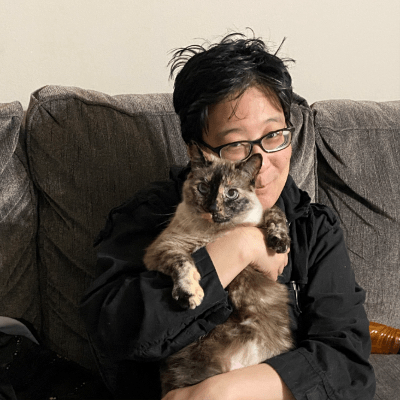
Yoon Ha Lee is a Korean-American sf/f writer who received a B.A. in math from Cornell University and an M.A. in math education from Stanford University, and is pursuing an MFA in media composition and orchestration at ThinkSpace Education. Yoon’s novel Ninefox Gambit won the Locus Award for best first novel, and was a finalist for the Nebula, Hugo, and Clarke awards. He has written comic scripts for Marvel (Doom’s Division #1-5) as well as game writing (Counterplay Games’ Godfall, Failbetter Games’ Winterstrike, Alderac Entertainment Group’s Legend of the Five Rings CCG).
Yoon’s hobbies include game design, fiber arts (spinning, weaving), and destroying the reader. He lives in Louisiana with his family and has not yet been eaten by alto clefs.
What’s your favourite part of the lifestyle of an Author?
The ability to go outside in nice weather and write, whether that’s in a notebook or on a laptop. (I am not cruel enough to inflict my manual typewriters on the neighbors.) Alas that “nice weather” is so rare in Louisiana!
What made you start writing?
I’ve told this story in other places, but when I was a small child, I had a vague notion that the way we got new books for the library was that at night, the ceiling opened up and books magically drifted down from Elsewhere. In 3rd grade, the teacher, Mr. McCracken, was big on getting us reading and writing, and that was when it dawned on me that (a) people write books, (b) I am a person. (c) ergo I can write books! (Sorry, third grade me was not big on syllogisms.) Because nobody tells USAn 3rd graders about self-employment tax or health insurance, I decided then and there that I was going to become a writer. Initially, this consisted of very short serial-numbers-filed-off stories based on Robin McKinley’s The Hero and the Crown and Walter Farley’s The Black Stallion because no one tells 3rd graders about copyright law, either. Fortunately, none of these monstrosities have survived!
Is there an Author that you consider your inspiration?
Too many to name! But the single writer who taught me the most about plotting and humor and subversion, about character and complication and the joy of pulp all gloriously whirled together, is Simon R. Green. I have his fantasy novel Blue Moon Rising damn near memorized.
If I get a second pick, Geraldine Harris’s Seven Citadels Quartet, a bildungsroman fantasy series with its meditations on immortality and death, the sharp and sweet edges of the human condition, hit me with the force of a religious text, and still does. (I am not currently religious.)
What’s your number one tip for an aspiring Author?
For love of little foxes, run the numbers. We all have different goals for our writing, and that’s genuinely fine, and it’s also genuinely fine for those goals to shift over time. But whatever it is you want out of your writing, if it involves the business or career side, run the numbers. It’s not always easy to get useful data or hard numbers on advances and/or income, and the industry is constantly in flux. If you want certainty, this is not a good industry for that. But to lesser or greater degree, it’s possible to make an educated guess about the operating parameters, decide what your risk tolerance is vs. what you’re willing/able to do, and make an informed decision. My original plan was to get a day job and write on the side in the hopes of writing full-time someday, knowing that it was possible I might never sell a single piece of writing. I got lucky after years of persistence, with the support of my husband; not everyone does, and it has a lot to do with timing and not necessarily anything to do with “literary merit” (whatever you conceive that to be). It’s a gamble, but you can at least make an informed gamble. That’s all any of us can do.
What type of book do you like to read and does this differ from the genre that you prefer to write?
This is unlikely to be a popular answer, but my favorite genre is nonfiction. I am the dork who sits in the science fiction convention hotel working through a math textbook (my B.A. is in math—no one’s perfect!) because it soothes my anxiety.
If I have to name a fiction genre…I read a lot of books that are not anything like what I prefer to write. In fact, reading something that doesn’t remind me of my day job is a relief! One of my favorite novels of all time is Rumer Godden’s In This House of Brede (which isn’t science fiction or fantasy in the slightest) and sometimes that surprises people. If we confine this further to speculative fiction, I’m weak for military science fiction and space opera, and that is what I usually write.
Which one of your characters would you most like to spend time with?
Excuse me, I had to be revived from a fit of the vapors. I give my characters difficult lives (when they survive at all) so it’s a common joke in my family that if they ever came to life, I am so, so very dead. I guess Shuos Mikodez from Machineries of Empire is the least likely to kill or torture me inhumanely for no reason. Alternately, Min from Dragon Pearl is like ten years old and I am not only a parent, I used to teach high school math so I reckon I can handle her. (Famous last words…)
Which book do you consider a must-read?
I don’t believe in must-reads! Everyone looks for, or needs, or wants, something different from their reading. If absolutely pressed, Rabindranath Tagore’s poetry collection Gitanjali. If it has to be a novel, then Italo Calvino’s Invisible Cities.
What’s been the hardest edit that you’ve had to make? Why did you want to keep the material in?
I’m fascinated that the default assumption here is that I would “want to keep the material in.” My anecdata observation is that many writers usually have to be persuaded (unless they stet) to cut material. I’m almost always asked to add material. I once sold a 900-word short story to an anthology on the condition that I add 400 words, which “inflated” the wordcount by almost half!
The most murderously difficult edit did involve cuts, and it was a work-for-hire short story-ization for younger audiences of the Clone Wars four-episode Umbara Arc. The editor was terrific, but I had a hard limit of 5,000 words, which is a lot to squish an hour-plus of television arc into. I remember my rough draft was over by one or two thousand words. Cutting the last 500 words took me four hours. I felt like a butcher because having seen the shooting (animating?) scripts as part of the job, that arc was a masterpiece of taut storytelling. I started with the obvious cuts in an adaptation to prose: I confined myself to a single POV and/or focal character; I pared down description to the bare minimum because the target audience (middle grade readers) probably knows a lot of Star Wars world lore so, like with fanfiction, I could omit certain details; adjectives and adverbs often ended up on the chopping block unless they were absolutely load-bearing. It was a terrific experience, though; I learned so much, and I loved revisiting one of my favorite arcs from that show.
If you could live in a book, which one would it be?
My problem is I gravitate toward grimdark dystopias, most of which I absolutely do not want to live in. My husband and I regularly joke that we’d like to move to Iain Banks’ Culture. Outside of that, my childhood answer was Anne McCaffrey’s Dragonsinger, second book of her Harper Hall trilogy. I was only mildly interested in the fire lizards, unlike most people I’ve talked to; I desperately wanted to study music theory and composition at Harper Hall!
If you could pick an Author to write your biography, who would it be?
I mean, I hope said author gets a choice in the matter! But if willing, I would ask Helen Kestrel, who has known me forever and probably knows all the blackmail and juicy gossip. (Helen, please wait until I’m dead!)
Is there any conflict between what you want to write and what you think your readers will like?
Yes? I write commercially, which is to say, writing pays the bills. It’s the day job that pays for the other endeavors. I hate doing the same thing over and over, but readers tend to want a reliable reading experience, and I have bills, so…
What effect can a review have on you, if you read them at all? Both the good and the bad.
I’m human and I shouldn’t read reviews, but I do peek from time to time. Usually they depress me because every time I finish writing a book, two weeks later I have a list of 5,377 things I want to fix and it’s too late to do so, but I remind myself that books are part of an ecosystem: no single book is going to be “right” for every reader, and even when it’s “right” for two readers, it may be for completely different reasons.
Here I admit that 80% of my motivation when writing something is “What do you mean, it’s not possible? I’ll show you!” so there’s that, too. My first published short story, “The Hundredth Question,” was written in second person, which writing advice usually tells you to avoid. I was literally a teenager when I sold that story to The Magazine of Fantasy and Science Fiction, so ever after, my perhaps unjustified attitude was “No one’s going to die of [$WRITING_DEVICE], so what happens if…?”
Can you sum up your life story in ten words or less?
“I’m bored, let’s go learn an obscure topic!”
(Yes. I run on weaponized boredom.)
What’s exciting you about your next project?
I’m currently nosing at a near-future cyberpunk/heist book on spec, half-written on weekends already. You know: she’s a retired assassin with too many bills after a cybernetic mod gone wrong, he’s a cybernetic mod that won’t hecking shut up about sight lines; together, they commit crime! I am no doubt going to be told to remove all the boring abstract algebra and/or fake sci-fi cryptanalysis deets again. (I’m on semi-hiatus from writing while I work on a part-time MFA in media composition and orchestration, so writing on spec lets me jot down scenes without dying of deadlines.)
The non-writing (ish) project is a 2D animation short that is inching out of preproduction, Candle Arc (CandleArc.com), which is an adaptation of my story “The Battle of Candle Arc” (Clarkesworld Magazine): big space battles, off-label uses of number theory, and a very angry goose. I love 2D animation because it’s already caricature and there’s scope for visual effects and metaphors that cannot be conveyed in the same immediate way through prose, like having someone “fire” a phoenix out of a handgun, or making characters “pixellate” into numerals for fake space magic number theory vibes! Or in any case, “special effects” visually don’t cost more to draw.
And finally, you have one quote to be remembered by, what is it?
“I’m your pun.”
You can find our more about Yoon Ha Lee, The Machineries of Empire series and their other works.
And you can find out more about the exciting Candle Arc project here:
 Zealot Script